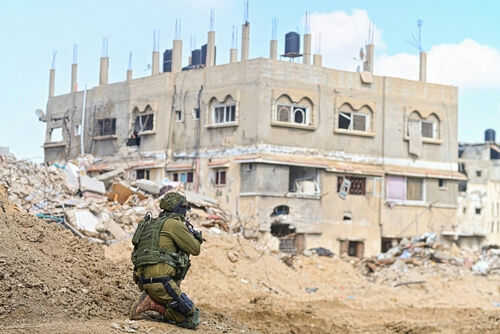
Israeli reservists say the ceasefire drew a yellow line on the sand—and then blurred it with bullets.
Story Snapshot
- United Nations officials warned of a pattern of shootings near Gaza’s “Yellow Line” that could constitute unlawful killings [2].
- Israeli military statements frame shootings as threat-based responses to individuals who crossed the boundary [3][4].
- Reporters and officials describe confusion over the line’s placement and visibility, fuelling disputes over each engagement [2].
- Transparency gaps on incident records and identification of the dead keep both claims fighting the same shadows.
What Allegations Say About Rules, Pressure, and a Painted Boundary
Israeli reservists and the veterans’ group Breaking the Silence allege that orders near the “Yellow Line” encouraged broad lethal force, with confusion over rules of engagement during the ceasefire creating room for fatal errors. The United Nations human rights office flagged a pattern of people shot near the line, warning that proximity-based killings would amount to war crimes if confirmed [2]. These claims converge on one hinge: when a person nears a painted boundary, what turns presence into a lawful target under a ceasefire?
United Nations official Ajith Sunghay described the boundary as lined with concrete blocks yet still contested in definition and application, amplifying the concern that civilians could be judged by distance rather than conduct [2]. The allegation intersects with testimony that soldiers felt pressure to treat approach as intent. That combination—ambiguous terrain cues and hair-trigger expectations—creates a scenario where the map dictates morality. The legal test, however, remains conduct, capability, and intent, not paint and proximity.
What The Military Says About Threats, Crossings, and Split-Second Calls
Israeli military statements consistently reject the proximity claim. The army reported killing four Palestinians after they crossed the line and were treated as a threat, framing each case as threat-based engagement rather than boundary-based execution [4]. Separate reporting described other incidents in northern and southern sectors where soldiers identified individuals near or past the line as threats before opening fire [3]. That account fits standard force doctrine: hostile act or demonstrated hostile intent, not mere location, drives the shot.
This official narrative carries two strengths and one notable gap. It presents a coherent rule—crossing plus threat equals engagement—and cites repeated field incidents to demonstrate practice [3][4]. Yet it does not supply the underlying records that would test each decision: after-action reports, target identification notes, or video corroboration. Without those materials, outside audiences cannot verify whether threat criteria were consistently met for each person killed near the boundary.
The Evidence Tension: Patterns Without Names, Statements Without Logs
The United Nations warning leans on pattern analysis—multiple fatalities near a single line—without public, incident-by-incident identities that separate militants from civilians [2]. The military counters with categorical statements but has not publicly matched each casualty to a specific, documented threat determination [3][4]. That is the crux. One side shows a troubling cluster; the other asserts lawful intent. Neither side, in the open record, resolves the who, what, and why for each body found near the yellow paint.
'Ceasefire is a JOKE': Israeli soldiers recount ongoing GAZA killings — AP
Troops describe confusion over where 'Yellow Line' actually runs, with vague orders & shifting boundaries leaving Palestinians at risk of being targeted
'We need to stop using the term,' one soldier said pic.twitter.com/wv2WhSn0rI
— RT (@RT_com) May 30, 2026
American conservative values offer a common-sense filter here. Security forces deserve the presumption of lawful action under real danger, but that presumption grows stronger when leaders show their work. If the army can release redacted engagement logs, geolocated boundary markings, and identity reviews of the deceased, the public can judge the difference between an approach toward troops and a civilian walking a poorly marked corridor. Accountability that protects operational security is possible—and overdue.
What Would Close the Distance Between Doubt and Proof
Three disclosures would turn argument into assessment. First, incident-level engagement packets: the specific rule of engagement applied, sensor or observer confirmation, command approvals, and post-incident reviews for each shooting near the line. Second, a boundary-marking audit: precise coordinates, photographs, and visibility standards by sector during the ceasefire period. Third, a casualty classification ledger: names, affiliations if any, and the behavioral indicators that led to lethal force. These steps would not satisfy everyone, but they would move debate from slogans to facts.
Sources:
[2] Web – Israeli army kills 4 Palestinians in Gaza, claims they crossed ‘yellow …
[3] Web – UN raises alarm over Israel’s killings of Gazans near armistice line
[4] Web – IDF soldiers kill terrorists in northern, southern Gaza Strip