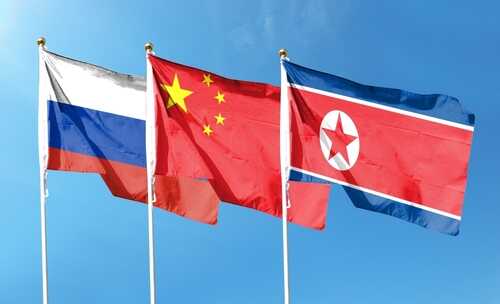
In a world that has seemingly forgotten the lessons of the past, Japan is sounding the alarm on a threat axis that could redefine global order as we know it.
At a Glance
- Japan’s 2025 defense white paper identifies a China-Russia-North Korea axis as a grave threat to global order.
- Increased military activities by China and Russia near Japan are escalating tensions in the Indo-Pacific.
- North Korea’s missile advancements and cooperation with Russia add to regional instability.
- The U.S.-Japan alliance remains crucial in addressing these emerging threats.
The Axis Threat
Japan’s 2025 defense white paper has delivered a sobering assessment: the China-Russia-North Korea axis poses the gravest threat to global order since World War II. This isn’t just a theoretical concern—it’s a reality unfolding in the Indo-Pacific, where Japan finds itself at the epicenter of a potential geopolitical earthquake. China’s assertive military activities in the East and South China Seas, including regular incursions near the Senkaku Islands, have alarmed Japanese defense planners. Coupled with Russia’s joint military exercises with China and its deepening ties with North Korea, the strategic calculus in the region is shifting dramatically.
Japan labeled China as “the greatest strategic challenge” since World War II in its 2025 defense white paper, highlighting geopolitical flashpoints as the rationale behind remilitarizing the nation.
Read more 👇 pic.twitter.com/3Jrw5RUuek
— The Epoch Times (@EpochTimes) July 17, 2025
North Korea’s missile programs, featuring hypersonic weapons and intercontinental ballistic missiles capable of reaching the United States, further complicate the security landscape. These developments aren’t happening in isolation; they’re part of a coordinated effort to challenge the post-World War II international system that has maintained relative peace for decades. Japan, recognizing the severity of the situation, has accelerated its defense capabilities, including the deployment of standoff missiles and the fortification of its southwestern islands.
Watch: Japan says China’s military activity a ‘grave concern’
Rising Tensions in the Indo-Pacific
The Indo-Pacific is rapidly becoming the focal point of global security risks. With Japan geographically and strategically positioned at the frontline, the stakes couldn’t be higher. The U.S.-Japan alliance serves as the cornerstone of Japan’s security policy, especially amid looming threats of potential conflict over Taiwan. The Taiwan Strait is more than just a flashpoint; it’s a vital sea lane that, if disrupted, could have cascading effects on global trade and security.
Recent incidents of near-collisions between Chinese and Japanese aircraft and the tripling of Chinese warship presence near Japan’s southwestern islands underscore the volatility of the region. These provocations aren’t merely aggressive posturing; they represent a calculated strategy by China to assert its dominance and challenge U.S. influence in the region. Russia, leveraging its strategic partnership with China, is also flexing its military muscle, further destabilizing the already precarious balance of power.
Strategic Responses and Implications
In response to these escalating threats, Japan is not standing idly by. The nation is boosting its defense budget and enhancing its military readiness, particularly in its southwestern islands. This strategic shift is not without its domestic challenges, as it marks a significant departure from Japan’s post-war pacifism. However, in the face of an emboldened China-Russia-North Korea alliance, Japan’s proactive stance is both necessary and prudent.
Heightened military alertness in Japan is paralleled by an increase in diplomatic tensions with China and Russia. The potential for miscalculation in contested areas, such as the Senkaku Islands, raises the specter of conflict. Moreover, the U.S.-Japan security cooperation is becoming increasingly critical, particularly concerning Taiwan and missile defense. The long-term implications of these developments could lead to an arms race in the Indo-Pacific, with regional states accelerating their military modernization efforts to counter perceived threats.