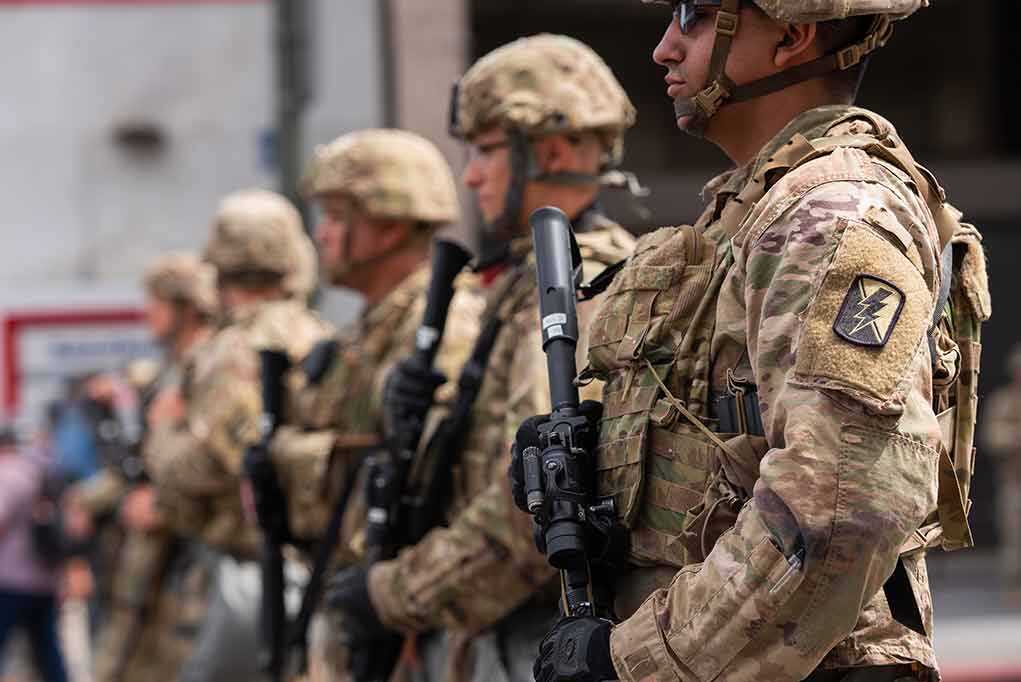
Two Tennessee National Guard soldiers on a downtown Memphis patrol shot and killed a 20-year-old civilian during a foot chase, raising hard questions about armed troops doing police work with no body cameras to prove what happened.
Story Snapshot
- Twenty-year-old Tyrin Johnson was killed by National Guard soldiers during a July 4 foot pursuit in downtown Memphis.
- Officials say Johnson was armed, had fired shots earlier, and turned toward the soldiers with a handgun before they opened fire.
- The family disputes the account and demands video proof, but the Guard had no body cameras, leaving a major evidence gap.
- The Tennessee Bureau of Investigation is reviewing the shooting as debate grows over using military forces in local policing.
What Officials Say Happened in Downtown Memphis
State investigators say the deadly chain of events started during crowded July 4 celebrations in downtown Memphis. The Tennessee Bureau of Investigation reports that Memphis Police officers were chasing Tyrin Johnson, age 20, after he allegedly fired shots in the area and ran with a handgun. Two National Guard soldiers assigned to the city’s “Safe Task Force” joined the foot pursuit and followed Johnson through the streets. Authorities say Johnson turned toward the soldiers while still holding the gun, and they fired. Johnson was pronounced dead at the scene, and no officers or Guard members were injured.
Memphis Police and state agents emphasize that Johnson was armed during the chase and that earlier gunfire in the area put the public at risk. Their statements frame the shooting as a response to a clear threat from an armed suspect during a chaotic holiday night. At the same time, officials admit that some details remain “under investigation,” including the exact path of the pursuit and the number and direction of shots fired. The Tennessee Bureau of Investigation acts only as a fact-finder and will turn its case file over to local prosecutors, who must decide whether the soldiers’ actions were justified.
Family Demands Proof and Raises Accountability Concerns
Johnson’s family quickly challenged key parts of the official story and called for hard evidence, not just officer testimony. His grandfather told reporters that Johnson carried a gun for protection after being attacked recently in Nashville and feared a social media feud. The family says Tennessee Bureau of Investigation agents informed them Johnson was shot twice in the chest, a detail they believe could conflict with claims that he was turning to shoot while running away. Most importantly, the grandfather says he is waiting to see if any video shows Johnson turning toward the Guard members with the gun, and he openly doubts their narrative until that proof appears.
That demand hits a wall because National Guard soldiers on street patrol were not equipped with body cameras. Without Guard footage, the public must rely on statements from Memphis Police, the soldiers, and any dashcam or security videos that may exist. This lack of direct visual evidence creates a serious gap at the very moment when the trigger was pulled. Similar Tennessee cases show why this matters: state agents often stress that situations “escalated” before shots were fired and later release full investigative files to help the public judge those incidents. Here, families and citizens are being asked to trust a deadly split-second decision without the kind of video record many Americans now expect.
Militarized Policing and Risks for Constitutional Rights
This shooting did not happen in a vacuum. Tennessee had already seen legal fights over putting armed National Guard troops into regular law enforcement roles in Memphis. Local Democratic officials sued to stop the deployments, arguing that using military forces for street patrols violated limits in the state constitution. A state appeals court overturned the injunction in 2025, clearing the way for the “Safe Task Force” that now includes Guard soldiers. That ruling means armed troops can work beside police in American cities, but critics warn it also blurs the line between civil authority and military power.
National Guard soldiers kill 20-year-old Tyrin Johnson in Memphis, Tennessee https://t.co/AbFSNxSRqm
— Angelos Papadopoulos (@angelohrg) July 7, 2026
National data show that gun homicides and police shootings hit hardest in big cities and in Black neighborhoods, where residents are already more likely to face gunfire from both criminals and officers. Research also finds that having more armed officials on scene does not always make violence less deadly; in some settings, an armed guard is linked to higher casualty counts when shootings occur. For many conservatives, this raises a serious concern: if more guns in government hands, with less transparency, lead to more questionable killings, then basic constitutional protections are at risk. That is why calls for body cameras on every armed official, clear rules for use of force, and rapid release of evidence matter so much in cases like Johnson’s.
What Conservatives Should Watch for Next
For readers who back strong law enforcement but also demand limited government, this case cuts both ways. On one hand, officers and Guard soldiers must face real threats from armed suspects in crime‑heavy downtown areas, and they deserve fair treatment when they act to protect lives. On the other hand, the state now has armed military personnel policing American streets without body cameras, and a young man is dead based largely on their word about a split-second turn. That kind of unchecked power clashes with the core conservative belief that government must be closely watched, especially when it can take a citizen’s life.
Key questions remain. Will Memphis Police and the Tennessee Bureau of Investigation release dashcam video, audio, and a full incident timeline so the public can see what really happened? Will forensic testing prove that Johnson fired his handgun during the pursuit, or only carried it? Will lawmakers tighten rules for when Guard troops can use lethal force or require cameras and stronger reporting? Civil rights groups, church leaders, and constitutional conservatives alike are now asking for full transparency. Until those answers come, the Johnson shooting will stand as a warning about the dangers of mixing military force, urban patrols, and weak accountability in our own cities.
Sources:
military.com, npr.org, youtube.com, facebook.com, newsfromthestates.com, abcnews.com, rockinst.org, jamanetwork.com, pmc.ncbi.nlm.nih.gov, casbs.stanford.edu