
Violent riots in Bologna left scores of officers injured as Prime Minister Giorgia Meloni drew a hard line between a needed investigation into a migrant’s death and what she called an unacceptable attack on law and order.
Story Snapshot
- Italian Prime Minister Giorgia Meloni demanded a full, rigorous probe into Abderrahim Fakir’s death in police custody.
- Meloni condemned Bologna’s street clashes as unjustified violence that left more than 50 law enforcement officers injured.
- She accused far‑left agitators of using Fakir’s death as a pretext to “set the city ablaze” instead of seeking truth.
- The unrest fits a wider European trend where radical protest movements turn tragic cases into excuses for chaos, putting officers and everyday citizens at risk.
Deadly arrest sparks riots and a law‑and‑order clash
The unrest in Bologna began after Abderrahim Fakir, a 42‑year‑old Moroccan man, died while being restrained during a police arrest attempt in the city’s Pilastro district. Video of the incident spread quickly online and drew emotional reactions across Italy, with some activists rushing to compare the case to the death of George Floyd in the United States. Within hours, large crowds moved into Bologna’s center, chanting against police and demanding “justice” as tension rose between demonstrators and officers.
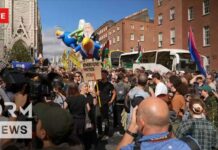
During the evening protests, masked groups in the crowd broke away from peaceful demonstrators and turned the streets into a battleground. They threw bottles and other objects at Italian State Police, damaged storefronts, and tried to push through lines set up to protect nearby businesses and public buildings. Police unions later reported that over 50 law enforcement officers were injured in the clashes, with many needing hospital treatment. Videos shared on social media showed burning trash, shattered glass, and panicked bystanders caught between violent agitators and riot police.
Meloni: “Truth on Fakir, but nothing justifies violence”
Prime Minister Giorgia Meloni responded quickly with a message that combined a demand for accountability with a clear defense of the officers under attack. She wrote that it is “essential” that any responsibility for Fakir’s death be investigated “with the utmost rigor” and that the truth be pursued “without prejudice and without leniency toward anyone.” Her statement made plain that the government is not giving a free pass to police or medical staff and expects prosecutors and courts to fully examine the case.
At the same time, Meloni drew a bright red line against the riots that followed. In a post carried by Italian outlet L’Unione Sarda, she said, “What happened in Bologna is unacceptable,” stressing that “nothing can justify violence against law enforcement.” She warned that those who “used this incident as a pretext to set the city ablaze, attack officers, and sow violence” were not seeking truth but “seeking confrontation” and feeding hatred against the police. That framing echoes her past stance, where she has backed officers while condemning far‑left street violence disguised as protest.
A broader pattern of radicalized protest against police
The Bologna riots do not stand alone; they follow a pattern seen across Europe where custody deaths or tense arrests become triggers for wider clashes with police. Amnesty International recently warned of a “sweeping pattern” of repressive laws and harsh protest crackdowns, but also noted growing confrontations as radical groups test public order limits. In Italy, repeated episodes in Turin, Milan, and other cities have mixed legitimate grievances with organized far‑left groups that look for any spark to bring chaos to the streets.
Prime Minister Meloni’s government has answered that pattern with a firm law‑and‑order agenda. After violent riots in Turin left more than 100 officers injured, her cabinet backed a security package giving police more tools to step in before protests spin into violence. Supporters see this as basic protection for officers and families who simply want to walk downtown in safety. Critics, including some rights groups, claim the measures risk chilling peaceful protest, even as they admit the seriousness of recent attacks on law enforcement.
What conservatives should watch in the Bologna case
For constitutional conservatives, the Bologna story highlights two key battles at once. First, there is the clear need to know exactly what happened to Fakir, from the use of pepper spray and restraints to the actions of medical staff on scene. Italian prosecutors have already opened a manslaughter file and registered two officers and four ambulance workers for review, showing that due process is moving forward. Demanding full facts and fair trials is not anti‑police; it is part of defending equal justice under the law.
No justification for Bologna riots after Moroccan man's death says Meloni. (ANSA) – ROME, JUL 21 – Premier Giorgia Meloni said Tuesday that there could be no justification for Monday's rioting in Bologna by protesters demonstrating about the case… #ANSA https://t.co/0spncFfZ49
— Ansa English News (@ansa_english) July 21, 2026
The second battle is protecting law enforcement and basic public order from radical groups that seize on tragedy to justify violent attacks. In Bologna, over fifty injured officers mean dozens of families wondering if mom or dad will come home safe from a simple shift. Meloni’s message—that truth must be found but that hatred of police and street warfare are “irresponsible” and “unacceptable”—aligns with core conservative values: backing the badge, rejecting mob rule, and refusing to let far‑left agitators turn real grief into another excuse to tear down Western society.
Sources:
lifesitenews.com, youtube.com, instagram.com, democrata.es, pollar.news, aljazeera.com, rtve.es, dw.com, statewatch.org