
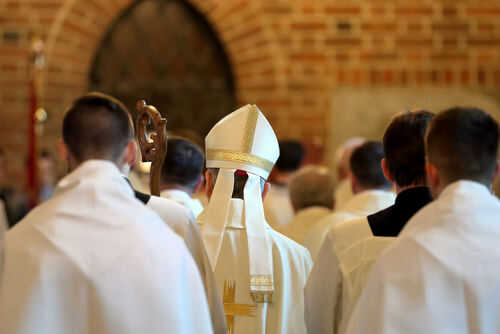
German bishops are testing Rome’s red lines on women’s ordination and sexuality, and the clash reveals how fast the global church can follow the same progressive path that hollowed out other historic Christian bodies.
Story Snapshot
- Germany’s Synodal Assembly backed women preaching at Mass and liturgical blessings for same-sex couples, with strong support from bishops.
- Reformers openly tied these moves to broader demands for women’s ordination and radical changes on sexuality and gender.
- The Vatican responded with a formal letter reminding German bishops that women’s ordination and homosexual acts are not up for negotiation.
- The fight echoes how The Episcopal Church legalized women’s ordination in the 1970s, a shift that helped fracture Anglican unity.
German Synodal Votes Push Progressive Agenda Inside the Church
Reports from the German Synodal Assembly describe a coordinated push to remake Catholic life in Germany along progressive lines. In March, delegates approved measures allowing women to preach at Mass and initiating blessing ceremonies for same-sex couples, framed as “appropriate liturgical celebrations and ceremonies” for these unions.[1] Of the 58 bishops who voted, 38 supported the women-preaching measure, nine opposed it, and 11 abstained, giving the proposal nearly eighty-one percent approval among voting bishops.[1] That level of backing signals institutional momentum, not fringe activism.
The same synodal process has repeatedly entertained texts that move directly toward sacramental women’s ordination and that advance transgender ideology.[4][6] Coverage of a prior vote noted “turbulent scenes” and ballots “for homosexuality, women’s ordination” at the Synodal Way, confirming that ordination is not a vague future idea but a formal part of the agenda.[4] Another report states that only ten of fifty-eight bishops opposed a measure calling on German bishops to “advance the issue of the sacramental ordination of women,” again underscoring how far a majority of that conference is willing to go.[6]
Rome Draws a Hard Line on Women’s Ordination and Homosexuality
The Vatican has not ignored Germany’s experiment. A letter dated October twenty-third, summarized by the National Catholic Register, informed German bishops that women’s ordination and changes to the Church’s teaching on homosexuality “cannot be subjects of discussion” in upcoming meetings with Synodal Way representatives in Rome.[3] The document cited Saint John Paul the Second’s teaching that the Church has “no authority whatsoever to confer priestly ordination on women,” a formula Pope Francis has “expressly reaffirmed,” making clear this is treated as settled doctrine, not a policy debate.[3]
The same letter warned bishops of “potential disciplinary consequences” for defying established teaching, including possible excommunication for “attempting to ordain a woman.”[3] On homosexual acts, Cardinal Pietro Parolin’s message stressed that while individuals must not be rashly judged, the “objective morality” of such acts cannot be redefined by any local church.[3] Vatican officials also cautioned that proposals like a permanent mixed Synodal Council to govern the Church in Germany risk a structural split from Catholic unity.[3] Rome’s response shows that for all the talk of “listening processes,” there are still bright doctrinal lines the hierarchy insists cannot be crossed.
From Women Preachers to Women Priests? Lessons from the Episcopal Precedent
Defenders of the German path argue that allowing women to preach at Mass is a limited, pastoral step, not ordination. Yet the same outlets reporting that change admit that “the question of opening up the priesthood to women in the church is not explicitly addressed,” which suggests a calculated, incremental approach where practice moves first and doctrine is pressed later.[1] The historical record of other denominations shows that such “small” liturgical innovations often serve as beachheads for much larger sacramental and moral revolutions.
“The Vatican has informed German bishops in writing that the ordination of women and changes in the Church’s teaching on homosexuality cannot be subjects of discussion in the upcoming meetings with delegates of the German Synodal Way in Rome.
The letter, dated Oct. 23, also…— Pope Respecter (@poperespecter1) May 19, 2026
The Episcopal Church in the United States offers a striking case study. After years of internal conflict, its House of Bishops voted in 1976 to amend church canons so that “women were finally eligible to be ordained to the priesthood and the episcopate.”[2] That decision followed earlier irregular ordinations and intense pressure from activists, but once the canonical barrier fell, the denomination rapidly embraced the full spectrum of progressive causes.[2] German reformers, who already champion same-sex blessings, birth control changes, and normalization of homosexual acts,[2] are traveling a familiar road. For conservative Americans who have watched mainline bodies empty out after similar experiments, the pattern is hard to miss.
Why This German Drama Matters for Conservatives in Trump’s America
Many readers see church disputes as “inside baseball,” but the German struggle fits the broader cultural fight that shaped the last decade in the United States. The same ideology that demands women priests, liturgical blessings for same-sex partners, and transgender language in church documents is the one that drove woke policies in public schools, corporate diversity schemes, and bureaucratic assaults on parental authority. German bishops and theologians now speak a vocabulary that sounds less like Saint Paul and more like Western gender-studies departments.[1][4][6]
For an older conservative audience that values ordered liberty, stable families, and clear moral teaching, what happens in Germany is another warning shot. Institutions that abandon objective truth in the name of “inclusion” do not stop at one compromise; they keep redefining doctrine until it matches the latest cultural fashion. Rome’s firm stance reminds us that boundaries still matter and that centralized authority sometimes must say “no” to preserve identity.[3] That lesson reaches far beyond the walls of any cathedral, into every American fight over schools, courts, and the public square.
Sources:
[1] Web – German Synodal Assembly allows women to preach at Mass, clears …
[2] Web – The Vote · Episcopal Church Women
[3] Web – Vatican Draws Line on Women’s Ordination and Homosexuality in …
[4] Web – Turbulent scenes and votes for homosexuality, women’s ordination …
[6] Web – Women’s ordination, transgender ideology move forward at German …