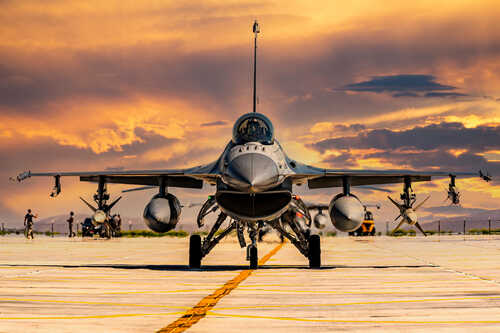
Three U.S. F-16 pilots say they were “hit” by a powerful blue laser on final approach to a NATO base in Germany, raising chilling questions about who is targeting American airmen and why our allies still struggle to stop it.
Story Snapshot
- Three U.S. Air Force F-16 pilots reported blue-laser strikes on nighttime approach to Spangdahlem Air Base in Germany.
- German police opened a criminal probe, calling the laser incidents a high risk to pilots and people on the ground.
- All jets landed safely, but the laser source and motive remain unknown, with no suspect publicly identified.
- The events highlight ongoing vulnerabilities facing U.S. forces overseas despite years of talk about “force protection.”
Nighttime Approaches Turn Dangerous Over NATO Soil
German authorities confirmed that three American F-16 pilots reported being illuminated by a blue laser beam on approach to Spangdahlem Air Base in western Germany, during three separate incidents in early December 2025.[3] Police in Trier, the regional investigative office, said the beams came from an unknown source just a few miles from the base between 8 and 8:30 p.m. local time.[3] All of the jets, assigned to the 52nd Fighter Wing, landed safely despite the midair harassment.[3]
The pilots described a conspicuous blue beam, bright enough to be noticed while they were focused on landing—a phase of flight where any distraction can quickly become deadly.[1][3] German police publicly warned that such laser attacks can cause severe impairment, temporary visual disturbances, or eye injuries, and therefore pose a “high risk.”[3][4] Investigators appealed to local residents for tips, acknowledging that they do not yet know who aimed the device, from where, or with what exact equipment.[3]
Criminal Investigation Opens, But Answers Are Scarce
The Trier criminal investigation department, part of the Rheinland-Pfalz state police, has formally opened a criminal case into what it calls laser beam “attacks” on the American jets.[3][4] Officials stated that two of the incidents occurred on December 2 and a third on December 9, all during nighttime approaches to the same air base.[3][4] Statements released so far emphasize the danger but offer no details on suspects, searches, or any seized equipment that might indicate whether this was mischief, terrorism, or foreign probing.
Spokesmen for the 52nd Fighter Wing stressed that American pilots are trained to deal with laser threats, immediately report the apparent source, and coordinate with both U.S. and German law enforcement.[2][3] The wing said its crews followed that playbook and that cooperation with German authorities is ongoing.[3] Yet public reporting still lacks basic facts: there is no publicly identified origin point, no recovered device, and no technical data on the laser’s power—leaving taxpayers and military families with more questions than answers.[2][3]
Laser Threat Fits a Growing Pattern Against Military Aviation
These incidents do not come out of nowhere. Earlier reporting highlighted similar laser strikes against U.S. fighter jets at Aviano Air Base in Italy, where the 31st Fighter Wing logged thirteen such incidents in 2023, up from four the previous year.[1] U.S. Air Force safety officials have long warned that lasers can cause flash blindness and disorientation, especially during takeoff and landing, and that a strong beam at the wrong moment could cost both aircraft and crew.[1] So far, no crash has been conclusively tied to a handheld laser.[1]
The broader problem is well established in civil aviation as well, where pilots frequently report laser illumination near airports while on final approach.[1] That pattern makes the Spangdahlem reports plausible as a serious safety hazard, even if investigators have not yet proved malicious intent. For conservatives who value a strong national defense, the key concern is whether repeated warnings are finally driving meaningful protective measures, or whether bureaucracies are simply filing another report and moving on.
Protecting American Pilots While Washington Debates
American commanders say they are trying to harden defenses. The U.S. Air Force has begun upgrading eyewear for aircrews to provide combined laser and ballistic protection, planning to field roughly 42,000 protective devices by 2027.[1] That long timeline underscores a familiar frustration: while our airmen face threats tonight, the system answers with multi-year procurement schedules and press releases. Meanwhile, it remains illegal but apparently still quite feasible for someone on the ground to aim a high-powered laser at a jet.[1][3]
3 U.S. Air Force F-16 Pilots Were Targeted by High-Powered Blue Lasers Near Spangdahlem Air Base in Germanyhttps://t.co/vVPjMXtxge
— 19FortyFive (@19_forty_five) May 15, 2026
For families with loved ones serving overseas, the Spangdahlem case feels like one more reminder that global deployments carry real risk even when there is no formal war. The Trump administration has pushed allies to take defense seriously and pay their fair share; these laser incidents test whether European partners can also deliver on basic security and law enforcement when American forces are targeted. Until investigators identify who did this and why, the message to would-be copycats is uncomfortably ambiguous.
Sources:
[1] Web – Probe Launched After 3 U.S. Air Force F-16 Fighter Pilots at …
[2] Web – Laser attacks nearly blind US F-16 pilots in terrifying midair ordeal
[3] Web – Probe launched after 3 Air Force F-16 pilots at Germany base …
[4] Web – Germany to investigate laser attacks on U.S. jets landing at NATO …