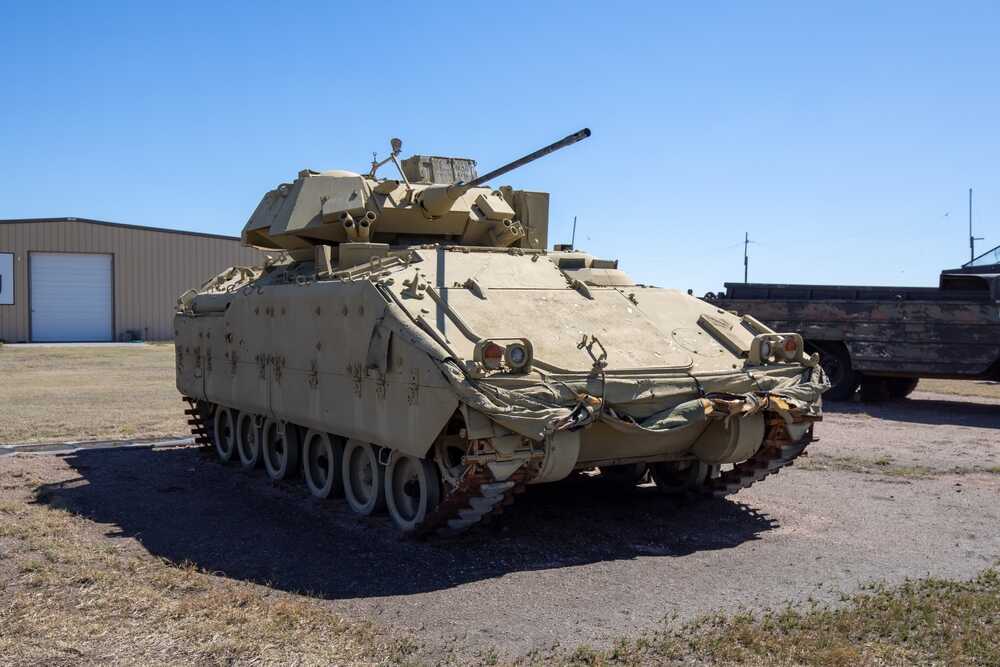
The U.S. Army’s Bradley Fighting Vehicle mirrors the F-35’s saga of endless delays, massive cost overruns, and persistent flaws—exposing decades of wasteful government spending that conservatives have long fought against.
Story Highlights
- Bradley development spanned 1960s-1980s with redesigns, testing scandals, and upgrades, akin to F-35’s troubled history of fiscal mismanagement.
- Responded to Soviet BMP threats but prioritized ambitious “overmatch” features over basic survivability, leading to congressional probes.
- Production approved in 1979 despite risks; over 6,000 units built by 1995, yet replacements fail amid ongoing upgrades.
- Recent Ukraine aid in 2023 proved combat value, but highlights procurement system’s “lousy tracked record.”
- Stakeholders clashed: Army pushed forward, testers like Col. Burton exposed armor gaps, contractors profited from the chaos.
Origins in Cold War Arms Race
U.S. Army Combat Developments Command initiated MICV studies in 1963 to replace M113 APCs after Vietnam. Soviet BMP-1 displays in 1967-1968 accelerated the program, demanding an infantry fighting vehicle with firepower and mobility. Early MICV-65 prototypes featured 20mm guns, firing ports, and diesel engines. 1960s tests of XM701 and XM765 evaluated aluminum and steel hulls. Cold War pressures required parity with Warsaw Pact vehicles, influencing specs to match M1 Abrams speed through U.S.-German MBT-70 collaboration.
Development Struggles and Controversies
1976 MICV Task Force merged scout and IFV roles, adopting the TBAT-II turret. Renamed XM2/XM3 in 1977, production gained approval in 1979-1980 amid armor and firepower disputes. Named Bradley in 1981 after Gen. Omar Bradley, first units fielded in 1983 with the 2nd Armored Division. Col. James Burton pushed live-fire overmatch tests in the 1980s, clashing with Ballistic Research Laboratory over delays. This feud triggered congressional inquiries, mirroring F-35-style bureaucratic battles that inflated costs and compromised readiness.
Stakeholders and Power Conflicts
FMC Corporation, later BAE Systems, manufactured 6,785 units by 1995, securing lucrative contracts. Lt. Col. Franklin Trapnell Jr. commanded the first Bradley unit in 1983 before managing the program. Army versus testers dynamics led DoD Secretary approval in 1980 despite risks. MICV Task Force, Army Systems Acquisition Review Council, and Congress shaped decisions. Contractors influenced specs for profitability, underscoring how defense industry insiders perpetuate endless upgrade cycles at taxpayer expense.
The U.S. Army’s Bradley Fighting Vehicle Was the F-35 Stealth Fighter of Armored Vehicleshttps://t.co/kHtdI5S8BL
— Harry J. Kazianis (@GrecianFormula) March 14, 2026
Modern Use and Persistent Issues
Production ended in 1995, but M2A3 variants entered recon service in 2014 and replaced Humvees in 2016 for better mobility. Pentagon sent 109 M2s to Ukraine in 2023 aid packages, with 50 in a $3B January announcement and 59 more. Ukrainian maintenance proficiency validated combat efficacy by mid-April 2023. Failed replacement efforts continue, shaping IFV doctrine through upgrades rather than new designs. Short-term 1988 test fixes improved survivability; long-term, 4,641+ U.S. units fielded, but procurement flaws persist.
Impacts Echo Conservative Concerns
Costly development drew Reagan-era critiques and spurred the Joint Live Fire program after probes. Exports to Saudi Arabia offset scrutiny, influencing global IFVs like Germany’s Marder to Ukraine. Economic strain from overruns burdens fiscal conservatives demanding accountability. Politically, Bradley’s endurance post-Vietnam lessons contrasts overambitious designs like F-35. SOFREP praises its versatility in mobility and firepower. Oversight groups highlight wasteful tests and stalled successors, reinforcing calls for procurement reform under President Trump’s efficient governance.
Sources:
https://www.idga.org/land/articles/history-of-modernizing-and-replacing-bradley-fighting-vehicle
https://www.pogo.org/analyses/the-armys-lousy-tracked-record