

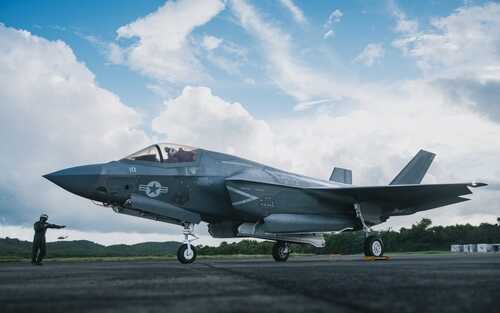
Lockheed Martin’s “Ferrari” F-35 proposal challenges the Pentagon’s future fighter jet plans, raising questions about defense priorities.
Story Highlights
- Lockheed Martin proposes a “Ferrari” upgrade for the F-35, offering advanced capabilities at a reduced cost.
- The proposal remains under Pentagon consideration, with no formal adoption as of January 2026.
- Integrating next-generation technologies into the F-35 could fill capability gaps until sixth-generation fighters are ready.
- Potential risks include modernization delays and resource competition with other defense programs.
Lockheed Martin’s Strategic Pivot
In a bid to maintain its competitive edge, Lockheed Martin has proposed a new “Ferrari” variant of the F-35 Lightning II. This “fifth-generation-plus” upgrade is designed to incorporate advanced technologies developed during the company’s Next Generation Air Dominance (NGAD) research phase. The proposal aims to bridge the gap until sixth-generation fighters are fully deployed, promising 80% of these capabilities at half the F-47’s cost.
CEO Jim Taiclet announced the concept in April 2025, shortly after Boeing’s F-47 won the NGAD contract. Lockheed’s approach targets the existing global F-35 fleet, attempting to extend the operational relevance of the world’s most successful stealth aircraft program by leveraging existing infrastructure and logistics capabilities.
‘Ferrari’ F-35 Stealth Fighter Has A Message for the U.S. Air Forcehttps://t.co/uVEs2DpmHu
— Harry Kazianis (@GrecianFormula) January 3, 2026
Pentagon Consideration and Challenges
Despite the ambitious proposal, the Pentagon has not yet formally adopted the “Ferrari” F-35 as of January 2026. Lockheed remains in active discussions with the Department of Defense, but significant hurdles persist. The current modernization efforts, including the Block 4 and Technology Refresh 3, are already behind schedule, raising concerns about resource allocation and the potential fragmentation of the F-35 fleet.
Critics warn that without proper controls, this initiative could exacerbate existing delays and strain defense budgets, potentially diverting funds from other critical programs like the NGAD and the F/A-XX naval fighter. The proposal’s success hinges on addressing these challenges without undermining the broader defense industrial base.
Implications for U.S. Defense Strategy
Adopting the “Ferrari” F-35 could fill immediate capability gaps, leveraging proven production and logistics infrastructure to enhance the existing fleet quickly. However, it also risks creating costly sub-variants, increasing sustainment and training burdens. Long-term, the initiative could extend the F-35’s relevance into the 2030s, but it must be balanced against the need to fund and develop next-generation platforms.
The strategic decision now rests on whether the enhanced F-35 can be developed without compromising the U.S. military’s long-term air superiority goals. The Pentagon’s choice will significantly impact Lockheed Martin, the defense industry, and international allies relying on the F-35 for their air defense capabilities.
Watch:
Sources:
Forget China’s J-20 or J-35A: The ‘Ferrari’ F-35 Stealth Fighter Is Coming
Lockheed CEO Says Firm in “Very Active” Talks with DoD on “Ferrari” F-35 with Sixth-Gen Tech
“Ferrari” Version F-35 Concept