
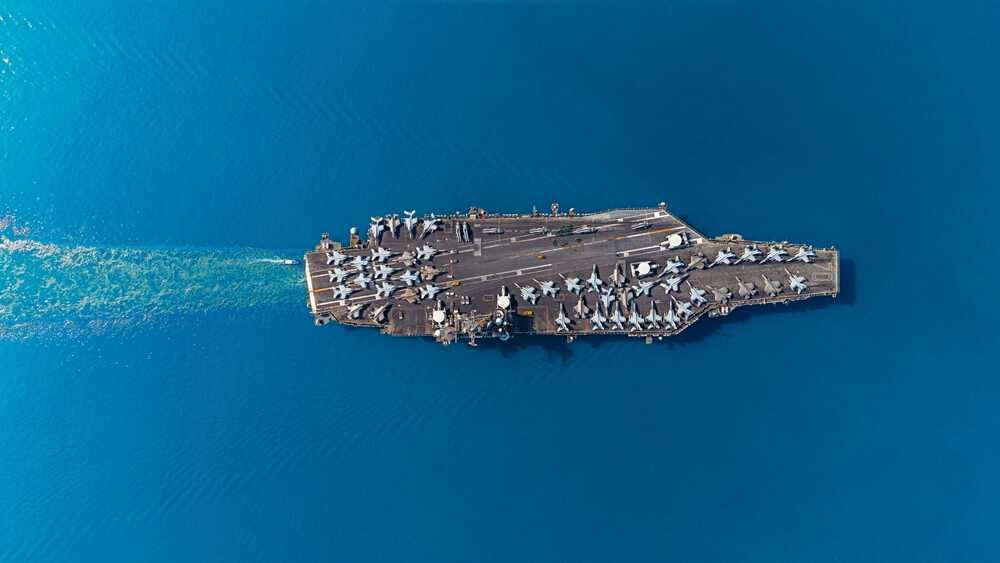
USS America packs 13 F-35B stealth fighters—on a ship half the size of a supercarrier—proving American ingenuity deters threats like China without endless deep state spending sprees.
Story Highlights
- USS America (LHA-6), at 45,000 tons, embarks at least 13 F-35Bs, nearing 20+ in full “Lightning Carrier” mode, doubling surge airpower.
- America-class trades floodable well decks for massive hangars, revolutionizing amphibious ships into light carriers for Indo-Pacific ops.
- Supports Marine Expeditionary Units amid China tensions, enabling first-day strikes and Expeditionary Advanced Base Operations.
- Recent ops in Philippine Sea (2024) and VMFA-242 flights (2025) confirm full F-35B integration since 2018.
America-Class Revolutionizes Naval Power
USS America, lead ship of the America-class amphibious assault vessels, sails the eastern Pacific with at least 13 F-35B Lightning II stealth fighters visible on deck, potentially more in the hangar. This 45,000-ton platform, half the size of a 100,000-ton Nimitz-class carrier, embodies the “Lightning Carrier” concept. Post-delivery refits added reinforced decks and hardened components for the F-35B’s short takeoff and vertical landing exhaust. U.S. Navy and USMC leaders praise this shift for “first day of war” strike capability, addressing post-Cold War air-centric needs.
Historical Shift from Wasp-Class to Aviation Focus
America-class evolved from Wasp-class LHDs, with Flight 0 ships America and Tripoli built without well decks since 2007 keel-laying. This design maximizes hangar space by up to 11,000 square feet for F-35B squadrons, unlike traditional amphibs carrying hovercraft like LCACs. Key milestones include 2013 Wasp-class mods, the first F-35B landing on USS Wasp in 2015, and America’s 2017 refit. By 2018, F-35B deployments became routine, supporting 7th Fleet operations.
Stakeholders Drive Indo-Pacific Deterrence
U.S. Navy’s Amphibious Force and 7th Fleet operate America-class for “Up-Gunned Expeditionary Strike Groups” with F-35Bs. USMC’s 31st MEU and squadrons like VMFA-121/242 provide aircraft, boosting strike and air defense for Marine Air-Ground Task Forces. Lockheed Martin supplies the versatile STOVL jets. Commanders including Vice Adm. Karl Thomas emphasize flexibility against China threats. Tensions arise as aviation priority reduces amphibious capacity for fewer Marines and landing craft.
Recent Operations and Expert Validation
As of August 2024, USS America with 31st MEU conducted F-35B flights in the Philippine Sea. February 2025 saw VMFA-242 takeoffs, while USS Tripoli validated Lightning Carrier in exercises. Vice Adm. Thomas noted ships can switch F-35Bs for MV-22 Ospreys. Experts at The War Zone call it a game-changer, trading wells for hangars to double carrier-like capacity. Consensus highlights versatility for contested seas, though some critique lost ground assault punch.
Strategic Impacts Bolster America First
Short-term, 20+ F-35Bs per ship double first-day airpower against anti-access/area-denial threats. Long-term, amphibs become distributed light carriers for EABO, reshaping doctrine. Navy gains surge flexibility; USMC trades some helo/LCAC spots. Allies like Japan benefit from forward presence. The $100 billion F-35 program sustains jobs at Lockheed and shipyards, politically strengthening deterrence without bloating federal overspend.
Sources:
Behold USS America Sailing With A Whopping 13 F-35Bs Embarked Aboard
Historic First: F-35B Lands on Wasp, Launching Era of Increased Navy-Marine Corps
F-35B Flight Operations Aboard USS America (LHA 6)
How Capable Lighting F-35Bs Japan Iran