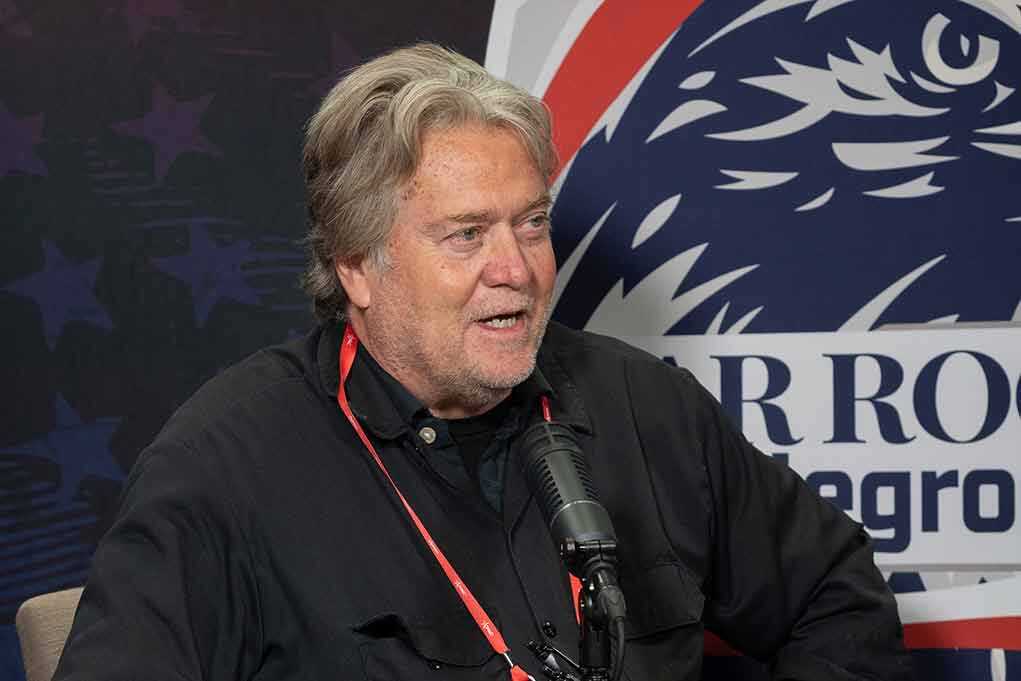
Steve Bannon’s War Room PM on Real America’s Voice is not a conventional news show but a standing platform for hard-edged, populist interpretation of events, where breaking stories become evidence in a larger narrative about institutional betrayal, partisan warfare, and the need for constant political mobilization.
At a Glance
- War Room PM is a recurring Real America’s Voice program built around Bannon’s partisan, “America First” commentary on U.S. and global politics, not neutral reporting.
- The show’s format mixes live reaction to breaking news with longer-running themes: election integrity battles, deep state accusations, and Middle East conflict.
- Program metadata and podcast archives confirm Bannon as the regular host, anchoring both AM and PM editions with a consistent populist, anti-establishment frame.
- The PM segments exemplify a broader trend in right-leaning media: transforming complex policy disputes into mobilizing narratives about corrupt elites and betrayed voters.
War Room PM: Format, Role, and Ambition
Real America’s Voice describes The War Room in simple terms: “Steve Bannon and special guests bring you the most important news from around the world,” airing live twice daily at 10:00 a.m. and 5:00 p.m. Eastern. That bare-bones description understates what the show is trying to do. War Room PM, in particular, functions as a daily evening digest where the day’s developments are assimilated into a populist storyline about power, patriotism, and betrayal.
Across the program playlist and YouTube uploads, Bannon is consistently identified as the on-air host of War Room, including labeled PM editions such as “WAR ROOM PM W STEVE BANNON” and “WAR ROOM WITH STEPHEN K. BANNON (EP. 5216).” Podcast archives from 2025 and 2026 show him opening episodes, framing topics, and driving the conversation with guests ranging from GOP strategists and conservative media figures to election activists like Mike Lindell. This repeated role is not incidental—Bannon is the brand and organizing principle of the show.
From News to Narrative: How War Room PM Uses Current Events
War Room PM’s distinguishing feature is not the stories it covers but the way it repurposes them. Where a traditional news program might treat a criminal referral against a special counsel or a Houthi threat in the Red Sea as discrete episodes, Bannon stitches them into a continuous argument about a country under siege—externally by hostile regimes, internally by corrupt elites and complicit institutions.
Take the Jack Smith segment summarized under “JACK SMITH REFERRAL EXPLODES AS MASS IMPEACHMENTS LOOM.” The starting point is a concrete event: a criminal referral from House Judiciary Chairman Jim Jordan accusing special counsel Jack Smith of misleading Congress about how his office obtained text messages from members of Congress. On War Room PM, that dispute becomes a showcase for broader claims about “weaponized” justice, alleged retaliation against Trump and his allies, and anticipated waves of impeachment aimed at Trump-era officials. Guests emphasize not just the technical question of perjury but a systemic narrative—prosecutors, Democrats, and parts of the bureaucracy are portrayed as engaged in a coordinated campaign to silence dissent and lock populist figures out of future office.
The same pattern appears when the show turns to foreign policy. In episodes focused on Iran and the Strait of Hormuz, Bannon and his guests combine operational detail—strike counts, naval deployments, militia capabilities—with strategic and moral judgments. One PM clip has him calling for “maximum pressure” on Iran through sanctions, currency warfare, and choke-points in the Strait, while explicitly opposing U.S. boots on the ground. Another weekend War Room discussion lays out the costs of prolonged Middle East engagements and questions the logic of open-ended missions in Lebanon or Iran, warning of Vietnam-style quagmires even as it calls for hard-nosed pressure on adversaries. Foreign crises, in other words, are processed through the same lens: elites are dragging Americans into long wars while failing to secure the homeland or protect the integrity of elections.
Election Integrity and the “War at Home” Frame
If foreign policy provides the drama, election integrity provides the spine. War Room, including PM editions, repeatedly argues that the most consequential battle is not in the Middle East or the South China Sea but in American counties, precincts, and data systems. In a July 13, 2026 episode framed around “CONFRONT ELECTION FRAUD NOW OR LOSE AMERICA,” Bannon opens by declaring that rigged voting machines and illegal voting represent the “greatest threat” to the country, eclipsing overseas conflicts. He castigates donor-driven Republican elites and “Israel first” instincts for neglecting what he frames as a domestic crisis.
Later episodes extend that theme. One AM segment has Bannon and John Solomon reinterpreting declassified intelligence documents to argue that China’s acquisition of voter registration data meets the intelligence community’s own definition of “election interference”—a definition they accuse agencies and mainstream media of quietly ignoring. A 2025 War Room episode structures an entire conversation around redistricting battles and election law, urging listeners to engage directly in local fights that will shape national power for a decade. For War Room PM, these claims are not occasional detours; they are central. The show’s evening installments frequently tie legal disputes, oversight fights, and Senate maneuvers back to a main premise: if elections are compromised, every other policy question is downstream of illegitimate power.
Populist Tone, Partisan Positioning, and Audience
War Room PM sits squarely inside the ecosystem of right-leaning, populist media. Real America’s Voice itself is widely described as a conservative outlet focusing on pro-Trump narratives and “America First” themes. Bannon’s own public identity—as a Republican strategist, media executive, and Trump ally—is inseparable from how War Room is received. The show embraces that positioning rather than trying to soften it. Episodes routinely criticize Democrats, establishment Republicans, and legacy media in the same breath, framing them as different faces of one entrenched elite.
Stylistically, War Room PM combines talk-radio cadence with cable-style urgency. There are “cold opens” where Bannon delivers monologue-style riffs that set the ideological parameters of the episode before guests appear. There are recurring rhetorical devices—references to “MAGA” grassroots warriors, denunciations of “cartel-connected” officials or “deep state” actors, and constant appeals to vigilance and activism. In one PM segment, Bannon attacks an Arizona secretary of state as a cartel-linked lawyer lecturing President Trump on “free and fair elections,” then pivots directly into an aggressive policy prescription for Iran. The messaging is designed to be clipped and shared: sharp characterizations, declarative takes, and clear villains.
Mechanics: AM vs PM Editions and Multi-Platform Reach
Formally, War Room is structured as a two-edition daily show—AM and PM—with overlapping but distinct roles. The Real America’s Voice schedule, along with playlist descriptions, places War Room live at 10:00 a.m. and 5:00 p.m. Eastern, seven days a week in the morning and weekdays in the evening. AM episodes often open the day with a broad sweep: overnight developments in foreign policy, new legal filings, tactical updates on the border or education policy. PM episodes tend to absorb what has happened during the day—committee hearings, media coverage, market movements—and position them within the show’s existing narratives.
Technically, War Room PM is distributed as live video on Real America’s Voice, archived YouTube clips, and podcast audio. The October 9, 2025 War Room episode, for example, appears in podcast form with Bannon as host alongside Dave Bossie, Matt Boyle, and Mike Lindell, covering Cabinet meetings, shutdown politics, European economic instability, and urban unrest. Other episodes are captured in fully numbered audio series (e.g., Episode 5216) that reiterate the blend of global crisis analysis and domestic “war at home” themes. This multi-platform presence matters: War Room PM is designed to be both destination viewing for a core audience and a reservoir of quotable segments for secondary circulation on social media.
Context: War Room PM in the Modern Right-Media Ecosystem
War Room PM is best understood as part of a broader media pattern rather than a standalone anomaly. Across the right-leaning spectrum, hosts use live commentary formats to frame breaking news as proof of institutional corruption, media manipulation, or partisan warfare. War Room’s archive shows precisely that pattern: episodes highlighting Middle East strikes, Chinese economic maneuvers, Texas school policy, and Senate floor tactics all resolve into a call for intensified activism and skepticism of elite narratives.
That does not mean War Room PM fabricates its topics; the show takes genuine events—criminal referrals, military deployments, legislative proposals—and refracts them through its chosen frame. The result is a highly consistent worldview: America is in a long conflict with external adversaries (Iran, the CCP, jihadist movements) and internal ones (bureaucrats, establishment politicians, legacy media). Elections and information flows are the decisive terrain. For viewers who already share these premises, War Room PM offers not merely information but emotional validation and tactical guidance. For skeptics, the same program reads as aggressive advocacy rather than analysis.
Limits of the Record and What We Know
The available documentation on War Room PM—network schedules, episode descriptions, podcast outlines, and detailed summaries—supports a clear conclusion: Bannon is the regular host, the show is built around current-events political commentary, and PM editions play a central role in turning the day’s news into a populist storyline. What the record does not always provide is a complete, line-by-line transcript of every PM segment. That gap matters when the question is about specific wording or a particular claim in a given episode; metadata and summaries can establish format and thrust, but they cannot substitute for verbatim quotation.
Even with that limitation, however, the overall contours are well documented. War Room PM is not a one-off webcast; it is a structured, recurring evening show within a larger two-edition franchise, explicitly oriented around politics, policy, and ideological mobilization. It reflects and amplifies a particular strand of American conservative media—combative, deeply skeptical of institutions, and convinced that the true “war” is being fought not only on foreign battlefields but in courthouses, school boards, and election systems at home.
Oh no! I adored this man – his intellect. com m on sense, fearless truth telling
We are lost without him. I hope Real Americas Voice (Steve Bannon) eulogizes him beautifully. I am literally in tears. I will miss him— Vicki Jo Pollina (@JoPollina) July 27, 2026
What It Means for Viewers and Politics
For the audience that tunes in at 5:00 p.m., War Room PM offers more than information. It provides a daily framework for interpreting events: who is on their side, who is betraying them, and what battles require attention next. The show’s emphasis on election contests, activist organizing, and policy fights illustrates how partisan commentary programs increasingly function as informal campaign infrastructure. Whether one sees War Room PM as a necessary counterweight to mainstream narratives or as a polarizing accelerant, its structure and content make one thing clear: this is not just a show about politics; it is a show that treats politics as permanent war, with the evening edition as one of its primary daily briefings.
Sources:
americasvoice.news, omny.fm, mediamatters.org