One profanity-laced Easter post from the commander-in-chief has now exposed a growing MAGA fault line over war, religion, and presidential restraint.
Quick Take
- President Donald Trump threatened Iranian infrastructure in a Truth Social post that included profanity and the line “Praise be to Allah,” escalating controversy amid the Iran conflict.
- Tucker Carlson rebuked Trump on-air, arguing that no president should mock Islam and warning that America “is not a theocracy.”
- The flare-up lands as Iran’s restriction of the Strait of Hormuz continues to strain global energy markets and raise the stakes for U.S. policy choices.
- The episode highlights a broader Republican-side split between hawkish pressure tactics and “America First” anti-intervention instincts.
Trump’s Easter Warning to Iran Triggers Blowback at Home
President Donald Trump’s Easter Sunday Truth Social message aimed at Iran blended a hard military threat with language that immediately drew criticism. The post warned of strikes on Iran’s power plants and bridges and demanded that Iran reopen the Strait of Hormuz, a key global oil chokepoint. The message’s profanity and its closing phrase, “Praise be to Allah,” became the focal point of the domestic dispute that followed.
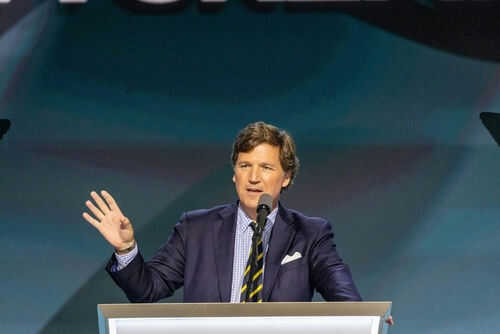
Tucker Carlson aired a pointed response the next day on The Tucker Carlson Show, quoting Trump’s post and challenging both its tone and its symbolism on a Christian holiday. Carlson’s criticism centered on the idea that mocking another religion is beneath the office and politically self-defeating in a conflict already tangled with identity and faith. Carlson also emphasized a civic principle, arguing the United States should not slide into religious-posturing politics.
Carlson’s Argument: War Rhetoric Shouldn’t Become Religious Rhetoric
Carlson’s comments did not read like a standard partisan media hit; they were framed as a moral and constitutional objection to how a president communicates during wartime. He argued that “no decent person mocks other people’s religions” and stressed, “We are not a theocracy.” That framing matters because it separates two debates that often get fused in modern politics: the case for force abroad and the temptation to turn foreign conflict into a cultural or religious crusade.
The exchange also reflects Carlson’s longer-running anti-intervention posture inside the broader right-of-center media ecosystem. In recent months, reporting has described internal friction among pro-Trump voices over how aggressively the United States should engage in the Israel-Iran fight and what, if any, “America First” limits should apply. Carlson has positioned himself with the restraint faction, arguing the costs and moral hazards of escalation should be confronted directly rather than buried under slogans.
Hormuz Pressure Raises Energy Stakes—and Tests “America First” Discipline
The underlying strategic driver remains the Strait of Hormuz. Iran’s restriction of the strait has been described as disruptive to roughly 20% of global oil flows, a number that helps explain why Washington is publicly leaning on Tehran even as Americans remain sensitive to energy prices. Trump’s post suggested a deadline-style escalation, pointing to “Tuesday” as a moment for punishing strikes—language that can move markets and harden enemy calculations even before any order is given.
For conservatives already wary of “forever wars,” the political risk is that emotional rhetoric substitutes for a clearly communicated national interest and measurable objectives. For liberals who distrust Trump’s instincts, the risk is the same problem through a different lens: a perception of impulsive decision-making in a high-consequence theater. The research available does not confirm what operational decisions followed the post, but it does show the communications fight is becoming part of the policy fight.
A Small Media Clash That Signals a Bigger Coalition Problem
Republicans control Washington in 2026, but that does not eliminate internal pressure from outside-government power centers—especially large independent media platforms that shape grassroots opinion. Carlson’s rebuke showed how quickly a prominent pro-Trump-aligned voice can go public when he believes the administration is crossing a line. Other coverage has described backlash and ridicule directed at Carlson from different corners of the MAGA world, underscoring that the base is not monolithic on foreign policy.
The practical takeaway is less about personality drama and more about governing coherence. If the administration wants public backing for coercive action against Iran, it will need discipline in tone, clarity in goals, and messaging that does not inflame religious tensions at home. Carlson’s critique, whatever one thinks of him, reflects a real voter sensitivity: many Americans are tired of elite-driven conflict spirals and suspicious when political leaders talk like war is a culture-war performance.
Sources:
Tucker Carlson Rages at Trump Over Easter Tirade: ‘Who Do You Think You Are?’
Tucker Carlson Humiliated as Big Trump Prediction Flops
Donald Trump Slammed for Bizarre ‘Nuclear Warming’ Rant in Tucker Carlson Interview
Tucker Carlson Met With Awkward Silence On Stage From MAGA Crowd