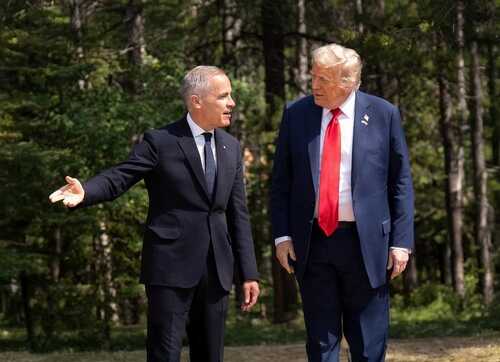
Trump’s hardball tactics and looming tariff threats could significantly shift the landscape of the U.S.-Canada trade.
At a Glance
- Trump threatens a 35% tariff on Canadian goods by August 1.
- Canada maintains a 25% counter-tariff amid tense negotiations.
- U.S. tariffs on steel and aluminum have doubled to 50%.
- Trade talks are active but face potential escalation.
Trump’s Tariff Strategy and Its Implications
The Trump administration has once again taken a firm stance on trade, with President Trump announcing a potential 35% tariff on Canadian goods if an agreement isn’t reached by August 1. This aggressive move follows a series of tariffs targeting not only Canada but also Mexico, the EU, and others, with the intention of securing better trade terms for the U.S. The administration has already doubled tariffs on steel and aluminum imports to 50%, raising concerns about the impact on businesses and consumers alike.
Melanie Joly responds to President Trump's announcement that 35% tariffs will be imposed on Canadian goods on August 1st.
"While the U.S. is becoming weaker, we will become stronger and we will diversify and turn ourselves towards Europe," she says. pic.twitter.com/OV3y03cFnd
— Wake Up America (@_wake_up_USA) July 13, 2025
The tariffs have sparked a trade war reminiscent of previous disputes under Trump’s leadership, such as the 2018-2019 steel and aluminum tariff conflict. With the U.S. market being a crucial destination for over three-quarters of Canadian exports, the stakes are high. The U.S. administration is leveraging its market size to extract concessions, aiming to protect domestic industries and reduce trade deficits.
Watch: Trump threatens 35% tariffs on Canada starting Aug. 1
Canada’s Response and Negotiation Dynamics
Canadian Prime Minister Mark Carney, along with Finance Minister Dominic LeBlanc, is navigating a delicate balance between defending national interests and avoiding further escalation. While Canada has paused new tariff threats, it maintains a 25% counter-tariff on U.S. steel and aluminum. These measures are designed to apply pressure without provoking an uncontrollable trade conflict.
Negotiations are ongoing, with high-level meetings taking place amid a backdrop of tense diplomatic relations. Canadian officials have downplayed the drama, with the Prime Minister even choosing to remain on vacation as talks continue. However, the looming deadline and potential for significant economic disruption keep tensions high.
Economic and Political Ramifications
The imposition of tariffs and the potential for a full-blown trade war have significant implications for both economies. In the short term, businesses on both sides of the border face uncertainty, particularly those reliant on cross-border trade in sectors such as steel, aluminum, automotive, and agriculture. Consumers could see price increases, and supply chains might experience disruptions.
Long-term effects could be even more damaging. A prolonged conflict risks eroding trust and damaging the integrated North American supply chain established under agreements like the USMCA. Companies may seek alternatives to U.S.-Canada trade, potentially weakening broader North American cooperation.
The Road Ahead
As the August 1 deadline approaches, all eyes are on the ongoing negotiations. The outcome will not only impact the immediate economic landscape but could also set the tone for future trade relations. The Trump administration’s hardline approach has generated record-high tariff revenues, but the broader economic and political costs remain to be seen.
The stakes are high, and the clock is ticking. With both sides preparing for further escalation, the coming weeks will be crucial in determining the future of U.S.-Canada trade relations.