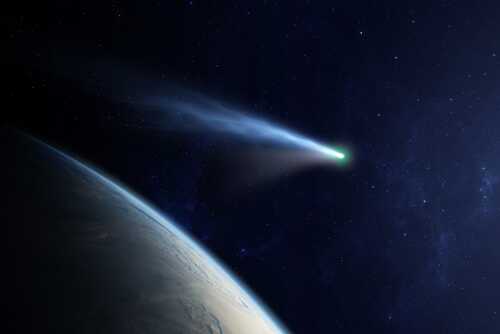
A mysterious Manhattan-sized interstellar comet emitting never-before-seen metal compounds is hurtling through our solar system, raising alarming questions about what our government agencies aren’t telling us.
Story Highlights
- Comet 3I/ATLAS emits unprecedented nickel tetracarbonyl compound never observed in nature
- International Asteroid Warning Network classifies object as “potential planetary threat” despite NASA’s reassurances
- Harvard scientist Avi Loeb questions official narrative, suggesting extraordinary phenomena warrant deeper investigation
- Object exhibits bizarre “anti-tail” behavior and non-standard flight path challenging established cometary models
Unprecedented Cosmic Visitor Challenges Scientific Understanding
The comet designated 3I/ATLAS, discovered by NASA’s ATLAS survey in Chile on July 1, 2025, represents only the third confirmed interstellar object ever detected in our solar system. Measuring approximately 5.6 kilometers across and traveling at 1.3 million mph, this massive celestial body exhibits characteristics that defy conventional cometary science. The Keck II telescope in Hawaii confirmed the object’s most disturbing feature: it emits four grams of nickel tetracarbonyl per second, a metallic compound never before observed occurring naturally in space.
Could mysterious Manhattan-sized comet be a ‘black swan event?’: ‘The implications are so huge for humanity’ – New York Post https://t.co/7rnH7XG1FA via @GoogleNews
— The Enlightened Whistleblower ~Common Sense News (@TheEnli72119052) October 24, 2025
What makes this discovery particularly concerning is the comet’s exhibition of an “anti-tail” phenomenon, where material jets point toward rather than away from the Sun. This behavior contradicts fundamental principles of cometary physics and suggests forces at work that current models cannot explain. The object’s trajectory also deviates from expected patterns, following what scientists describe as a “non-standard flight path” through our solar system.
Official Response Raises More Questions Than Answers
NASA’s response has been notably defensive, with officials repeatedly emphasizing that 3I/ATLAS poses “no actual risk to Earth” despite the International Asteroid Warning Network’s classification of it as a “potential planetary threat.” This contradiction between agencies should raise red flags for any American who values transparency in government. The space agency launched a dedicated monitoring mission involving multiple spacecraft and telescopes, including Hubble, Webb, and Swift observatories, suggesting far more concern than their public statements indicate.
Watch: Suspicious comet may herald ‘black swan event’: Astrophysicist Avi Loeb | Elizabeth Vargas Reports
Government Agencies Struggle to Maintain Control of Narrative
The timing of 3I/ATLAS’s approach coincides suspiciously with increased public interest in space threats and government transparency regarding unidentified aerial phenomena. The object passed within 17 million miles of Mars on October 3, 2025, and reached its closest approach to the Sun on October 29-30. It will become visible again from Earth in mid-November 2025, providing another opportunity for independent observation that government agencies cannot control or suppress.
The detection of nickel tetracarbonyl emissions without corresponding iron represents a scientific impossibility according to current understanding of natural processes. This phenomenon alone should prompt serious questions about whether our government possesses knowledge about cosmic phenomena that contradicts their public messaging. The fact that no previous comet has exhibited these characteristics suggests either a fundamental gap in scientific understanding or deliberate obfuscation of information that could have profound implications for national security and public awareness.
Sources:
As NASA Missions Study Interstellar Comet, Hubble Makes Size Estimate
Baba Vanga’s 2025 Alien Prophecy Sparks Global Debate as Mysterious Comet 3I/ATL
Comet 3I/ATLAS NASA Protect Earth
NASA Discovers Interstellar Comet Moving Through Solar System
3I/ATLAS: A City-Sized Alien Spacecraft