

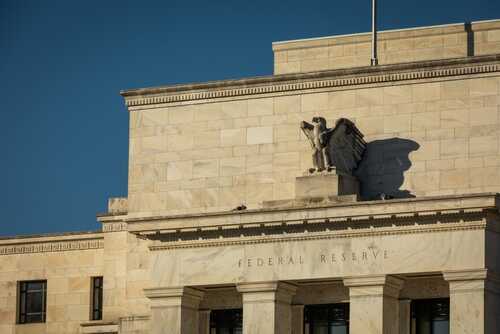
As Americans grapple with a housing crisis, the Federal Reserve’s renovation of its headquarters has sparked outrage for its staggering $2.5 billion price tag.
At a Glance
- The Federal Reserve’s HQ renovation costs have ballooned from $1.9 billion to $2.5 billion.
- HUD Secretary Scott Turner criticizes the spending amid a housing crisis exacerbated by high mortgage rates.
- President Trump escalates criticism of Fed Chair Jerome Powell, calling for his removal.
- Fed defends renovation as necessary for safety and long-term savings, despite public backlash.
Renovation Costs Soar Amid Housing Crisis
The Federal Reserve’s renovation of its Marriner S. Eccles Building in Washington, D.C., initially budgeted at $1.9 billion, has soared to an eye-popping $2.5 billion. This dramatic increase is attributed to inflation and construction challenges brought on by the pandemic. The timing couldn’t be worse, as many Americans face a housing crisis fueled by high mortgage rates tied to the Fed’s interest rate policies.
“While continuing to run a deficit since FY23 (the first time in the Fed’s history), the Fed is way over budget on the renovation of its headquarters,” Office of Management and Budget (OMB) Director Russ Vought said. “Now up to $2.5 billion, roughly $700 million over its initial… pic.twitter.com/7vC7L4ETrE
— The Epoch Times (@EpochTimes) July 15, 2025
Critics, including Housing and Urban Development Secretary Scott Turner, argue that the Fed’s reluctance to lower interest rates is making homeownership unattainable. Turner blasts the renovation as a colossal waste of taxpayer dollars, drawing a stark contrast with HUD’s cost-saving relocation to Alexandria, Virginia, which is projected to save $22 million annually.
Watch: Why the Federal Reserve’s Building Renovation Costs $2.5 Billion
Trump’s Escalating Criticism
President Trump, known for his direct approach, has intensified his critique of Jerome Powell, Fed Chair. Trump’s dissatisfaction centers around the renovation’s exorbitant cost and the Fed’s interest rate policies, which he blames for choking the housing market. The President’s calls for Powell’s removal underscore a growing frustration with what he perceives as bureaucratic excess and misplaced priorities.
Trump’s administration has formally questioned the Fed’s renovation spending, demanding accountability and transparency. Powell responded by emphasizing the project’s necessity for ensuring safety and operational efficiency, highlighting measures such as public disclosures and Inspector General audits.
Fed’s Defense and Political Ramifications
The Federal Reserve maintains that the renovation is crucial for modernizing outdated systems and ensuring safety. Despite scaling back certain features to control costs, the project remains a lightning rod for criticism. The Fed stresses that all contracts are competitively bid and subject to rigorous oversight to ensure fiscal responsibility.
The controversy over the renovation has become a political flashpoint, especially as the 2024 presidential election looms. The debate over the Fed’s spending priorities versus its independence is likely to intensify, with implications for broader discussions on federal spending and agency relocations. The Trump administration’s vocal stance has already sparked public scrutiny and political maneuvering.
Implications for the Future
The escalating costs of the Fed’s renovation project and the political firestorm surrounding it have far-reaching implications. While the Fed argues for the long-term benefits of modernized facilities, the issue raises questions about government spending priorities, especially amid a housing affordability crisis. The public’s growing frustration over federal expenditures could influence future policies and agency relocations.
As the housing market remains strained by high mortgage rates, the spotlight on the Fed’s spending practices is unlikely to dim anytime soon. This controversy serves as a stark reminder of the delicate balance between fiscal stewardship and the operational needs of government institutions.