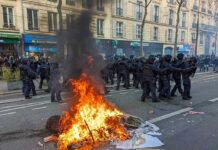
German police clashed with left-wing protesters as the Alternative for Germany met in Erfurt on the 100-year shadow of Weimar-era history, testing free assembly and democratic tolerance today.
Story Highlights
- AfD convention in Erfurt coincided with the 100th anniversary of a 1926 Weimar-era Nazi congress, sparking fierce protests.
- Historians accused AfD of “dog whistle” symbolism, while the party flatly denied intent and pressed on with business.
- Police confronted large crowds and blockades as Germany’s culture war over speech and legitimacy spilled into the streets.
- AfD re-elected Alice Weidel and Tino Chrupalla, signaling discipline ahead of key state races.
Protests Erupt As Party Meets Under Tight Security
German police faced thousands of demonstrators in Erfurt as the Alternative for Germany began its convention. Organizers on the left sought to block access and disrupt the meeting. Officers used cordons and moved crowds after blockades formed on key routes. News outlets reported scuffles, detentions, and a heavy police footprint across the city. The unrest turned a routine party gathering into a national stress test over free assembly and political pluralism in a major European democracy.
AfD delegates arrived to chants labeling them a threat to democracy. Protest leaders claimed moral duty to stop the meeting. Police maintained routes so accredited attendees could enter. Footage showed tense standoffs near barriers. The scene echoed battles over speech seen across the West. Many Germans disagree deeply over immigration, national identity, and the bounds of acceptable politics. Those divides drove bodies into the streets and shaped the images seen worldwide from Thuringia’s capital.
The Date Dispute: Symbolism Claim Versus Party Denial
Historians and critics said the July 4 date echoed the second congress of the National Socialist German Workers’ Party held in Weimar in 1926, one hundred years earlier. They argued the timing was a layered dog whistle to the far right. A noted historian called the choice a deliberate symbolic act. AfD leaders rejected that claim and said there was no intent to link the events. The meeting took place in Erfurt, not Weimar, though both cities are in Thuringia.
Supporters of the symbolism charge stressed that the 1926 congress followed the party’s re-establishment and carried weight in Nazi history. They argued that, given AfD’s classification by authorities as “extreme right,” the coincidence looked too neat. Critics saw pattern and purpose. AfD’s denial stood against those readings, and no primary records surfaced to prove intent. The split showed how modern politics fights over memory as much as policy, with dates and places turned into weapons.
Inside The Hall: Leadership Consolidation And Electoral Focus
While streets boiled, the party moved through its agenda. Delegates backed the leadership duo of Alice Weidel and Tino Chrupalla. The vote signaled unity before high-stakes state races in the east, where AfD hopes to convert polling strength into power. Reuters reported the re-election as a key step toward tighter discipline. The party framed itself as a voice on border control, energy costs, and national sovereignty, themes that resonate with many rural and working voters.
🇩🇪 Massive protests disrupt AfD party congress in eastern Germany
🔵 Around 20,000 protesters block highway and several access roads as demonstrations move toward convention center in Erfurt https://t.co/QF4k3wRuUV pic.twitter.com/NWgbPx9cqg
— Anadolu English (@anadoluagency) July 4, 2026
Conservatives who value open debate saw a core test: do critics get to decide who meets, when, and where? German media framed the protests as a defense of democracy. Yet democracy also protects meetings we dislike. When police must push through blockades so a legal convention can take place, the line between protest and coercion blurs. That line matters for free societies, in Europe and here at home, where speech and assembly face rising pressure from activist vetoes.
Why This Matters To American Readers
Germany’s clash mirrors fights the United States knows well. Elites often label insurgent parties as illegitimate. Crowds try to block events rather than debate them. Police end up refereeing politics. The result is fear and anger on both sides. That model erodes trust and hands power to mobs. The American answer should be clear: defend speech, hold firm on law and order, and let voters judge parties at the ballot box, not in the streets with barricades and fists.
Europe’s energy shocks, migrant crises, and inflation changed its map of politics. New parties rose by speaking to costs, borders, and culture. Old parties answered with shaming and bans. Germany is a case study in that standoff. Whether or not AfD picked a date for coded meaning, mass disruption as a tactic teaches the wrong lesson. If ideas are dangerous, better arguments must beat them in open sunlight. That is how free people push back without copying the illiberal playbook.
Bottom Line: Principles, Not Punch-Ups
Police in Erfurt kept a controversial event from being shut down by force. Historians alleged symbolism; AfD denied it; the records so far do not prove intent either way. What is proven is this: civil order and free assembly hang together. When they break, the loudest crowd wins. Americans should watch and remember. We defend the Constitution by protecting speech, winning arguments, and voting. We do not defend it by blocking doors or criminalizing debate.
Sources:
youtube.com, theleftberlin.com, unherd.com, romea.cz, dw.com, yahoo.com