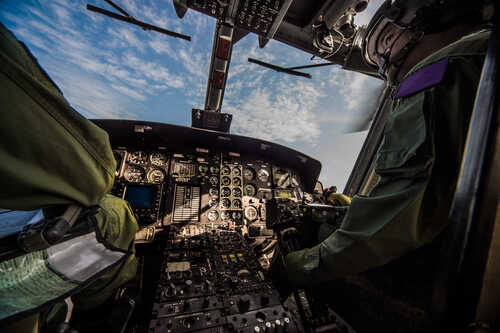
President Trump says Iran shot down a U.S. Apache helicopter near the Strait of Hormuz—and he vows consequences.
Story Snapshot
- Trump said the military told him Iran downed a U.S. Apache; he says America must respond [1][3][5].
- Reports say both pilots were rescued and are uninjured after a first-of-its-kind sea drone operation [1].
- The Pentagon and Central Command said the cause was still under investigation in early reporting [1][3].
- U.S. officials cited by major outlets pointed to an Iranian drone as the attacker [1][3].
What Trump Announced And Why It Matters
President Trump posted that the U.S. military informed him Iran shot down an Army Apache helicopter near the Strait of Hormuz. He wrote that both pilots survived and that the United States “must, of necessity, respond to this attack” [1][3][5]. His statement set the tone for fast-moving coverage. It framed the event as hostile action by Iran and signaled that a U.S. response is on the table. That message aims to deter more attacks and reassure allies.
Major outlets quickly reported Trump’s claim and his warning of consequences, quoting his Truth Social post directly [1][3][5]. Two U.S. officials cited by reporters said an Iranian Shahed-style drone shot the helicopter [1][3]. At the same time, early Pentagon language said the cause was still under review [1][3]. That split—presidential certainty versus ongoing inquiry—created a narrow window where facts and policy signals moved in parallel.
What We Know About The Crew And The Rescue
Trump said two pilots were safe and uninjured, and outlets reported they were rescued soon after the helicopter went down [1][3][5]. Central Command announced a historic recovery using an unmanned surface vessel, described as a first-of-its-kind operation at sea [1]. That detail confirms a real incident, a rescue, and an active U.S. presence near the Strait. It also shows recent U.S. investments in drones can save lives and shorten rescue times under threat.
Reports placed the mission near the Strait of Hormuz or off Oman’s coast, which matches the region’s tense pattern of Iranian harassment and drone activity [1][3][5]. That chokepoint carries a large share of the world’s oil. Any attack there risks higher energy costs and global shocks. American patrols in that corridor exist to keep sea lanes open. When a U.S. aircraft is taken down in that space, it challenges freedom of navigation and, by extension, our economy at home.
Attribution: What Is Confirmed And What Is Pending
Trump’s charge puts blame on Iran, and multiple outlets quoted U.S. officials pointing to an Iranian drone [1][3]. However, the Pentagon and Central Command were cited as saying the cause was still under investigation in initial reporting [1][3]. That means the public has not yet seen sensor tracks, wreckage analysis, or intercepts. Until those materials are released, the open record rests on the President’s statement and unnamed officials. That is common in fast-breaking security events.
The lack of public technical detail leaves some open questions. Reports used different terms—“shot down” or “hit by a drone”—without a single official brief to settle the method [1][3]. There is no quoted admission from Tehran in the materials provided [1][3][5]. Those gaps do not erase the rescue or the danger to U.S. forces. They do remind us that decisive action should ride on strong evidence, both to punish the right target and to sustain allied backing if events escalate.
Policy Stakes For Deterrence And The Homefront
Clear, firm red lines protect our troops and our trade routes. A U.S. response, if confirmed by evidence, would aim to restore deterrence and stop more drone attacks on American assets [1][3][5]. Precision matters. A measured strike on the responsible nodes—drone operators, launch sites, and support hubs—can impose costs while limiting wider war. Public release of key findings, when safe to share, would build trust and cut through media noise that can distort early facts [1][3].
US Apache helicopter shot down by Iran over the Strait of Hormuz! Trump: 'The Iranians shot down one of our highly sophisticated Apache Helicopters…
The United States must, of necessity, respond to this attack.'
Both pilots are safe and uninjured.
But markets are nervous —… pic.twitter.com/rXK2chyws2— Papa Johns (@SVTrivo) June 9, 2026
For families at home, the link is simple. Attacks on U.S. patrols near Hormuz threaten oil routes. That can raise fuel prices and strain household budgets. Americans already carry the load from years of bad energy policy and higher costs. Protecting sea lanes and our service members supports stable prices and national strength. The Constitution gives the Commander in Chief the duty to defend our people. That duty starts with truth, evidence, and resolve—together.
Sources:
[1] Web – Iran’s Regime Shoots Down U.S. Helicopter, Trump Says He Will Strike …
[3] Web – Trump Claims Iran Shot Down U.S. Apache Helicopter Near Strait of …
[5] YouTube – Trump says Iran shot down U.S. helicopter