
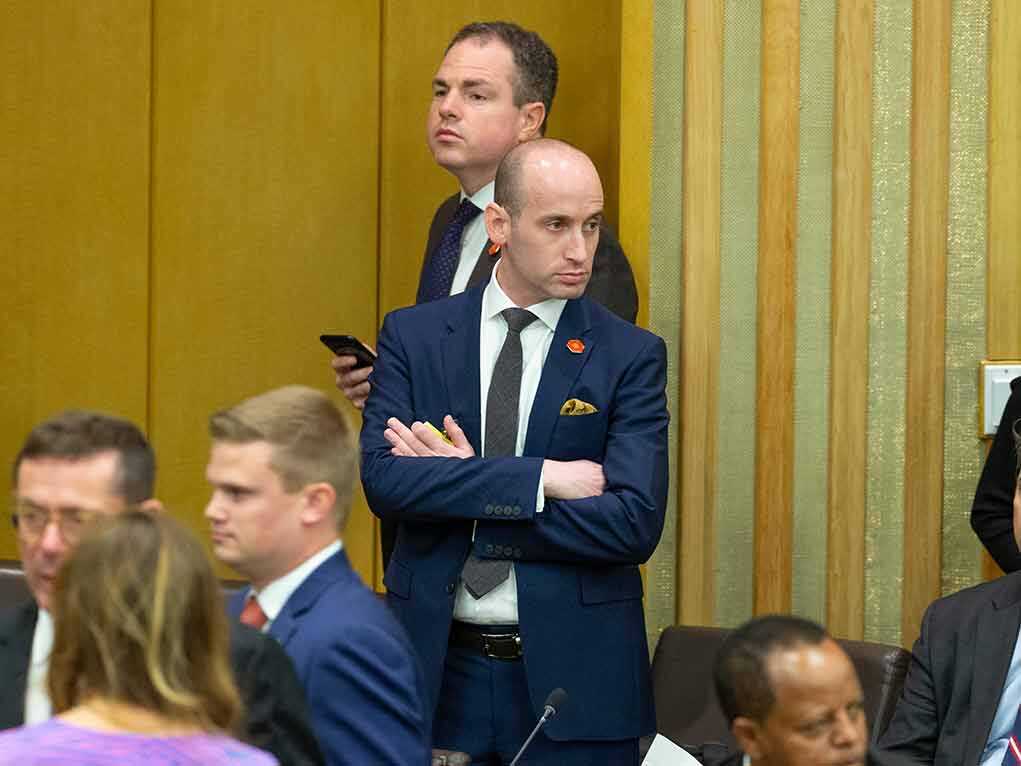
President Trump promoted Stephen Miller, the man behind his deportation crackdown, to White House chief of staff — and industries that depend on illegal labor are furious that enforcement is actually working.
Story Snapshot
- Trump named Miller chief of staff on November 6, replacing Susie Wiles, drawing anger from immigrant-labor-dependent industries.
- A new construction survey found 29% of firms felt some impact from immigration enforcement, with 12% losing workers outright.
- Miller has long argued there is no real shortage of low-skilled labor among American workers.
- The U.S. economy added 165,000 jobs in October, undercutting claims of broad economic damage.
Miller’s Promotion Signals Enforcement Will Continue
Trump elevated Stephen Miller to White House chief of staff on November 6, replacing Susie Wiles. The Washington Post reported the move angered, frightened and stunned industries that rely on immigrant labor, calling Miller the “chief architect of deportations.” For conservatives who voted for secure borders, that reaction is proof the policy is doing exactly what it was designed to do.
The timing matters. Industry leaders voiced their complaints just days after millions of Americans weighed in on immigration policy at the ballot box. Rather than retreat, Trump promoted the official most associated with tough enforcement, replacing a chief of staff seen as more cautious on the issue. That is a clear signal the administration plans to keep the pressure on.
Construction Firms Report Worker Losses, But Most Saw No Impact
A 2026 workforce survey from the Associated General Contractors of America found 29% of firms reported some effect from immigration enforcement, with 12% saying workers left or failed to show up over actual or rumored immigration actions. Another 16% said subcontractors lost workers, and 42% blamed worker shortages for project delays. Still, 71% of firms reported no enforcement impact at all over the same six-month period, a fact often left out of the panic headlines.
Labor shortages were already the top cause of construction delays before the survey period even began, and 55% of firms had already canceled, postponed or scaled back a project in the prior six months. That means builders were struggling long before Miller’s promotion, and pinning fresh blame on a personnel change rather than years of industry-wide staffing problems stretches the evidence thin.
Miller Has Long Rejected the “Labor Shortage” Argument
Miller made his position clear back in 2017, telling reporters there is no actual shortage of lower-skilled labor in America. “If you look at the premise… of bringing in low-skilled labor, it’s based on the idea that there’s a labor shortage for lower-skilled jobs. There isn’t,” he said, framing restriction as a way to help unemployed Americans find work.
Reporting on Miller’s record shows he pushed Immigration and Customs Enforcement toward a target of 3,000 arrests per day, far above prior administrations, and directed agents to target anyone in the country illegally rather than only those with criminal records, including day laborers gathering near Home Depot stores. That record is exactly why industries dependent on cheap, often illegal labor see his promotion as a threat to their bottom line.
President Trump defended his decision Friday to replace White House Chief of Staff Susie Wiles with Stephen Miller, moving Wiles to his political operation.
“Sometimes in life you have to make moves,” Trump told reporters as he left the White House Friday for an event in Cape… pic.twitter.com/hLFl7Tcd7n
— Mosheh Oinounou (@Mosheh) November 6, 2026
Meanwhile, the broader economy is not collapsing under enforcement, as critics predicted. The U.S. added 165,000 jobs in October, with gains in health care, manufacturing and white-collar work. That strength does not erase every sector’s struggles, but it punctures the narrative that strict immigration enforcement is dragging down the entire American economy. Industry groups complaining about labor costs have an obvious financial stake in looser enforcement, a fact that deserves as much scrutiny as their warnings.