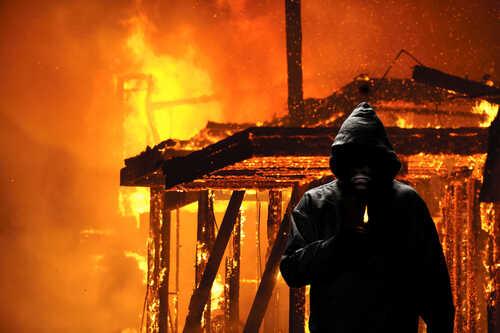
A violent arson attack on a Texas family exposes the dangerous erosion of community safety, raising urgent questions about law enforcement and the protection of American families.
Story Snapshot
- A Texas family of six narrowly escaped a deliberate arson attack while they slept, with the suspect still at large.
- The mother publicly accused the arsonist of attempted murder and announced the family’s relocation for safety.
- Arson remains a persistent threat in America, strongly tied to urban decay, poverty, and gaps in law enforcement.
- Experts warn that such crimes have deep psychological impacts and highlight the need for robust prevention and justice.
Family Targeted in Violent Arson: Trauma and Fallout
A Texas family of six, including two children, became the latest victims of a calculated arson attack, barely escaping their burning home after a hooded arsonist set it ablaze while they slept. The mother, fearing for her family’s lives, publicly accused the perpetrator of intending to kill them and announced plans to move for their safety. This incident underscores the real and present dangers law-abiding families face when violent criminals operate unchecked in their communities.
🔥👀 Check this GRIFF MAG !#Texas family of 6, including 2 children, narrowly escape house fire set by hooded arsonist while they slept via @GRIFF_HBR_MAG#ShowBiz #Sports #Celebs #Lifestyle #US #UKhttps://t.co/CAOoNizmwa
— Alias GRIFF (@GRIFF_HBR_MAG) August 18, 2025
The immediate aftermath has left the family traumatized and displaced, while the arsonist remains unidentified and at large. Law enforcement continues its investigation, but the lack of swift arrests has heightened anxiety among neighbors. The family’s forced relocation illustrates the long-term disruption violent crime can cause, often stripping victims of their sense of security, community roots, and peace of mind. The broader community now faces increased fear and uncertainty, reflecting a systemic problem that demands urgent attention.
Watch a report:
Arson in America: A Persistent and Growing Threat
Arson is a major threat to American families, with an estimated 267,000 fires attributed to arson every year, resulting in $1.4 billion in property loss, thousands of injuries, and hundreds of deaths. Studies show that arson disproportionately strikes poorer neighborhoods, which are up to 14 times more likely to be targeted than affluent areas. While vacant properties are common targets, occupied homes, as in this Texas case, are also vulnerable—especially when personal vendettas or intimidation are factors.
High-profile cases like this one highlight the ongoing failures of public safety policy and the urgent need for law enforcement to prioritize the protection of law-abiding citizens. Socioeconomic factors, including poverty and urban density, drive up arson rates, but the ultimate responsibility rests with criminals who exploit these vulnerabilities. Community and federal interventions have met with limited success, especially in urban areas, underscoring the need for a return to policies that put Americans’ safety first and crack down on violent offenders.
Long-Term Impact and Policy Implications
The aftermath of arson leaves lasting scars—not just on direct victims, but entire neighborhoods. Families like the one targeted in Texas face trauma, displacement, and financial loss, while communities suffer from eroded trust, declining property values, and rising insurance costs. In the long run, unchecked violent crime can fuel a climate of fear, discourage investment, and undermine the fabric of American society. These consequences demand a policy response rooted in accountability, strong law enforcement, and support for victims.
Sources:
Arson in Chicago: Patterns and Correlates – Justice Policy Journal
Arson: National Fire Data Center – U.S. Fire Administration
Arson: Measurement, Analysis, and Prevention – Office of Justice Programs
Fire Loss in the United States – National Fire Protection Association
USFA Fire Data and Statistics Reports