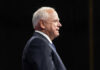
NASA Administrator Sean Duffy’s bold plan to deploy a nuclear reactor on the Moon by 2030 signals America’s determination to dominate space before China claims lunar territory for communist expansion.
Story Overview
- Sean Duffy announces aggressive 2030 timeline for 100-kilowatt lunar nuclear reactor deployment
- Initiative directly targets China’s growing lunar ambitions and space militarization threats
- Nuclear power essential for sustained American presence during Moon’s two-week-long nights
- Project positions lunar base as critical stepping stone for future Mars missions and space dominance
America’s Nuclear Moon Race Against China
Acting NASA Administrator Sean Duffy has declared an urgent timeline to establish American nuclear power on the lunar surface, warning that China poses an immediate threat to U.S. space leadership. During multiple August 2025 announcements, Duffy emphasized the strategic imperative of deploying a 100-kilowatt fission reactor by 2030. The administrator’s stark warning about potential “war in space” underscores how lunar energy infrastructure has become central to national security concerns and America’s ability to maintain technological superiority.
🚨🌎 “We’re in a race to the Moon, we’re in a race with China to build a Nuclear Reactor on The Moon”
“There’s a part of the Moon everyone knows best, there’s ice & sunlight there & we have to get there first to claim it”
NASA Chief Sean Duffy just declared the race to colonise… pic.twitter.com/vHQgKERgkA
— Concerned Citizen (@BGatesIsaPyscho) August 5, 2025
Duffy’s dual role as NASA Administrator and Secretary of Transportation positions him uniquely to coordinate this ambitious interagency initiative. His public statements consistently frame the lunar reactor project as both a technological necessity and a geopolitical imperative. The 2030 deadline represents an aggressive acceleration of previous timelines, reflecting the administration’s recognition that space dominance cannot be ceded to adversaries who reject American values and constitutional principles.
Watch: Sec. Sean Duffy to announce plans for nuclear reactor on the moon
Technical Requirements for Lunar Energy Independence
The Moon’s harsh environment presents unique challenges that make nuclear power the only viable solution for sustained American operations. Lunar nights last approximately two weeks, rendering solar power inadequate for continuous base operations and critical life support systems. The proposed 100-kilowatt reactor would provide sufficient energy to power a small lunar base, enabling permanent American presence and resource extraction capabilities that China desperately seeks to control.
NASA’s previous Kilopower project from 2017-2022 successfully demonstrated small-scale fission reactor technology for space applications, providing the technical foundation for this expanded lunar initiative. The reactor design builds upon decades of American nuclear innovation, leveraging expertise that communist nations have repeatedly attempted to steal through cyber espionage and technology transfer. This lunar deployment represents not just exploration advancement but a demonstration of American engineering excellence that authoritarian regimes cannot replicate.
Strategic Implications for American Space Leadership
The lunar nuclear reactor initiative directly supports the Artemis program’s goal of establishing a permanent American presence on the Moon while countering China’s expanding space ambitions. Chinese lunar research stations and resource extraction plans threaten to establish facts on the ground that could challenge American interests and international law. Duffy’s timeline ensures America reaches critical lunar territories first, securing strategic positions for both scientific advancement and national defense purposes.
This project will stimulate American aerospace and nuclear industries, creating high-paying jobs while advancing technologies with dual civilian and defense applications. The reactor deployment establishes precedent for American-led space resource utilization, countering authoritarian attempts to claim exclusive lunar territories. Success positions America as the leading space power for Mars missions and deeper space exploration, maintaining the technological edge essential for defending constitutional values against hostile nations.
Sources:
NASA Chief Explains Push for Nuclear Reactor on the Moon
Fox Business Interview on Lunar Nuclear Strategy