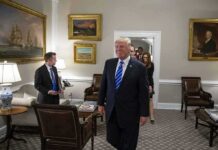


The most consequential people in any White House are rarely the ones with the grandest titles; they are the ones who control what the president sees, hears, and signs off on in the ninety seconds before a decision gets made. By that measure, Natalie Harp — an executive assistant on paper, drawing a $150,000 salary — has become one of the most powerful unelected figures in the Trump administration, not through policy expertise but through sheer physical and informational proximity to the man himself.
Key Points
- Reporting from The New York Times and CNN describes Natalie Harp as an informal but highly consequential conduit who relays messages, texts, and Truth Social content directly to and from President Trump, often bypassing standard staff channels.
- Foreign leaders unable to reach the president through official diplomatic or NSC channels have reportedly contacted Harp directly to get word to him.
- Harp reportedly worked at the White House for more than a year without a routine security clearance before the issue was escalated to White House counsel and Trump himself.
- Press Secretary Karoline Leavitt and Trump allies including Stephen Miller have publicly defended Harp as a loyal, ordinary staffer — a characterization that does not directly contest the reporting on her gatekeeping role.
- Harp’s rise fits a long-standing pattern in presidential history: informal, loyalty-based gatekeepers accumulating outsized influence by controlling access rather than by holding formal authority.
What Harp Actually Does Inside the West Wing
Strip away the tabloid gloss and Harp’s function is straightforward, if unusual for a staffer with no formal deputy title: she is the human interface between Trump and the flood of information, allies, and outside actors competing for his attention. The New York Times described her as “the utmost gatekeeper to President Donald Trump, a one-woman conduit of information operating entirely outside the usual chain of command,” someone who “texts with world leaders on the US president’s behalf”. CNN’s reporting corroborated the core mechanics — passing messages from allies, arranging meetings, drafting Truth Social posts, and carrying printouts of favorable coverage, all while maintaining near-constant physical proximity to the president.
That last detail — the printer — is not incidental color. Multiple outlets independently confirmed Harp’s habit of hauling a portable printer to hand Trump physical copies of articles and social posts throughout the day, earning her the nickname “human printer” among staff. In an administration where the president consumes information in bursts, often reacting to whatever lands in front of him, control over that flow is not a clerical function. It is a form of policy influence, exercised without a policy title.
Foreign Leaders and the Bypass Problem
The most striking claim in the reporting, and the one with the greatest institutional weight, is that foreign leaders unable to reach Trump through the National Security Council, State Department, or normal diplomatic backchannels have instead texted Harp directly. People magazine’s summary of the Times’ reporting put it plainly: world leaders text Harp “when other official channels prove fruitless”. Wikipedia’s entry on Harp notes a specific instance in which she posted a message sent to Trump by Ukrainian President Volodymyr Zelenskyy that had been intended as private communication — a detail that illustrates both her access and the informality with which sensitive diplomatic exchanges have reportedly moved through her.
This is where the story stops being a personality profile and becomes an institutional one. The NSC and State Department exist precisely to ensure that diplomatic messages are logged, vetted, and routed through officials with the security clearances and institutional accountability to handle them. A system in which foreign heads of state route around that structure to reach an aide directly represents a genuine departure from how information is supposed to flow to a president — regardless of what her formal title says.
The Security Clearance Question
The most concrete, verifiable fact in this story is also the least deniable: Harp reportedly worked at the White House for more than a year without the routine security clearance expected of staff in her position, an issue that surfaced only after the White House counsel’s office raised it and Trump himself intervened. Multiple outlets, including Forbes and the Guardian, reported this detail with matching specifics. This is not a matter of interpretation or characterization — it is a documented administrative fact about clearance timelines, which is harder to spin than questions of “how influential” someone is.
How the White House Has Responded
Fairness requires weighing the administration’s pushback, and it deserves a clear-eyed look. Press Secretary Karoline Leavitt told multiple outlets, including Forbes, that “Natalie Harp has a security clearance like everyone else, and she is a loyal and hardworking member of President Trump’s team”. Stephen Miller separately called her “one of the hardest working, most loyal and most talented staffers I have ever worked with”. These are genuine, on-record statements, and they deserve to be taken at face value rather than dismissed.
But it is worth noting precisely what these statements do and do not address. None of them dispute that Harp texts with foreign leaders, drafts the president’s social media posts, or serves as an informal routing point for information reaching him. They affirm her loyalty and work ethic; they do not contest the mechanics of her role as described by the Times and CNN. Leavitt’s clearance statement, moreover, addresses her current status — not the year-plus during which reporting says she operated without one. The White House’s defense, in other words, answers a different question than the one the reporting raises.
You are reading this story only because the White House didn’t want you to
Ossoff’s line about Trump’s close aide enraged the West Wing. But its efforts to silence the story inadvertently took it from the shadows to the mainstream
Meet Natalie Harp: https://t.co/ghItQsL8V2
— Jonathan Lemire (@JonLemire) August 21, 2026
Why This Is Not Unprecedented — and Why It Still Matters
Every modern White House has had its access-controllers. Chris Whipple’s history of chiefs of staff describes the role as “the toughest job in Washington” precisely because controlling who reaches the president is itself a form of power, tracing back to Sherman Adams under Eisenhower and running through figures like Doug Band in Bill Clinton’s orbit. What distinguishes Harp’s case is not the existence of a gatekeeper — that is structurally inevitable — but the informality of the arrangement: no clearance for over a year, no defined chain of command, and a channel apparently open enough that foreign governments have used it as a workaround. That combination, more than her job title or her devotion to the president, is what makes this an institutional story rather than merely a personnel one.
Sources:
mediaite.com, nytimes.com, cnn.com, yahoo.com, thedailybeast.com, theguardian.com, en.wikipedia.org, people.com, independent.co.uk